
UpBand
UpBand is an IELTS Writing coach for phones. It scores an essay against the four criteria a real examiner uses, tells you which sentence to fix, and turns vocabulary into a daily habit rather than a list you reread. There are two of us on it. Product and engineering are mine, so everything from the app down to the database is something I wrote.

The Problem
IELTS Writing is scored on four criteria: Task Achievement, Coherence and Cohesion, Lexical Resource, and Grammatical Range and Accuracy. Each one runs 0 to 9. It's the section people most often underperform in, and it's the hardest one to study on your own.
There are three walls if you're preparing alone. You get no feedback signal, so you can write twenty essays and have no idea whether you're improving, and having one marked by a human costs around $50. You hit a vocabulary ceiling, and Lexical Resource is a quarter of the grade. And you have no curriculum, because “practise more” isn't a study plan.
The Decisions
- 01
The grader shows its reasoning
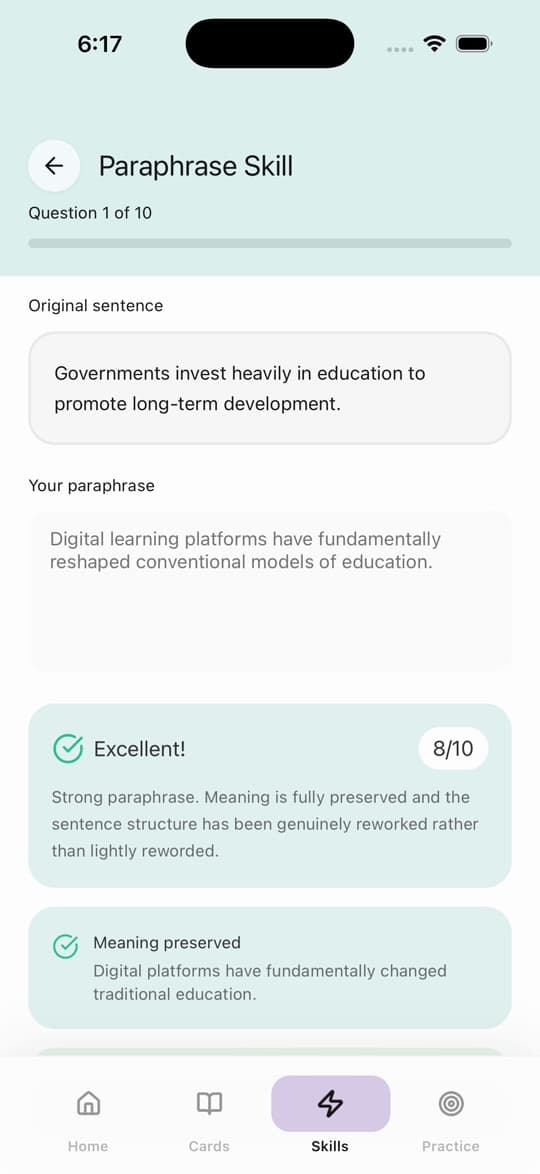
It doesn't just return a band score. It says which descriptor it applied and why, quotes the sentences that cost you marks, and rewrites them. A number on its own teaches you nothing, and nobody trusts a number they can't argue with. The quoted line and the rewrite are the part that turns feedback into something you can act on tomorrow morning.
- 02
The grading prompt never ships inside the app
Evaluation runs in Supabase Edge Functions rather than on the phone. Keeping the API key off the client is the obvious reason and the smaller one. The real reason is that the prompt encodes the rubric, and the rubric is the product. Ship it in a binary and anyone who wants it can unpack it.
- 03
Half the drills never call a model
Sequencing and question-type identification have deterministic right answers, so rules check them. Only paraphrasing and grammatical structures go to the model. Sending a question that has exactly one correct answer to an LLM spends tokens and adds a round trip to buy nothing. It's the less impressive answer on a slide. It's also the difference between a demo and something I can afford to leave running.
- 04
A wrong answer costs you one level, not all of them
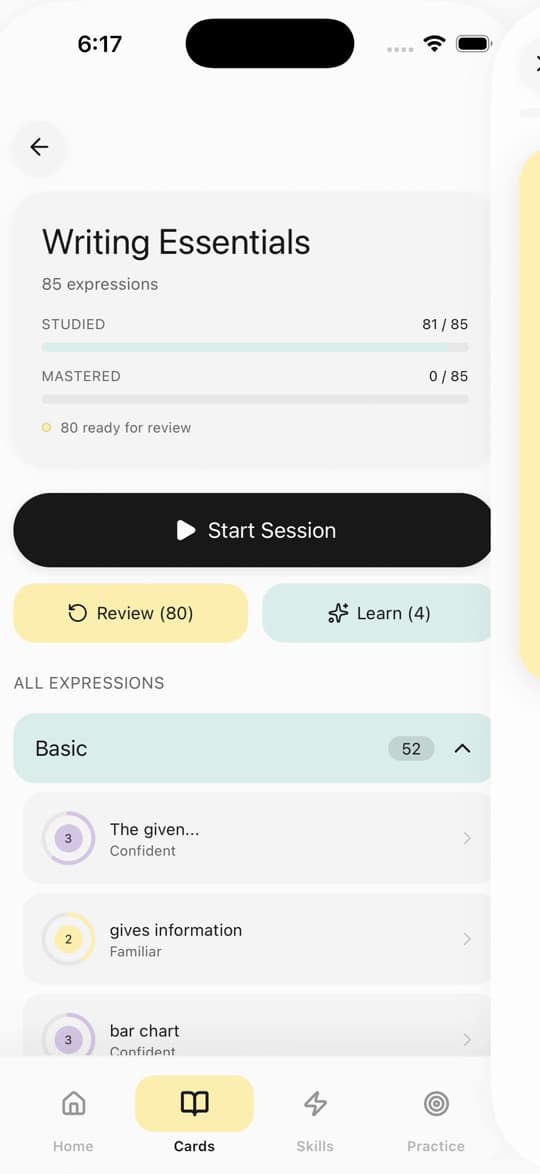
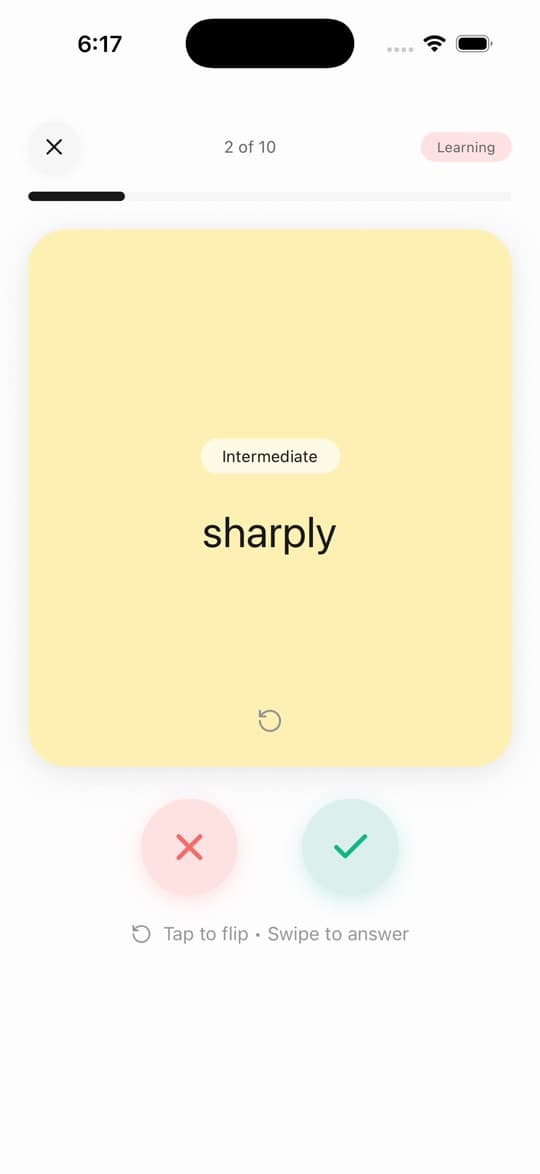
Cards sit on a six-level ladder, with reviews at 0, 1, 3, 7, 14 and 30 days. Get one right and it moves up a level. Get it wrong and it drops one, instead of resetting to zero. Resetting is the usual behaviour and it's the crueller one. A bad morning on a word you've known for weeks shouldn't wipe a month of scheduling. What it costs me is that a genuinely forgotten word takes longer to work its way back down to daily review. I'd rather that than have someone stop opening the app.
- 05
A dead network gives you a worse score, not an error screen
When the evaluator can't be reached, the drill screens fall back to a local heuristic check. You still get a score, a model answer, and credit for the session. It's less accurate than the real thing. It's also much better than dead-ending someone who sat down to study. The session stays useful when the network isn't.
What Shipped
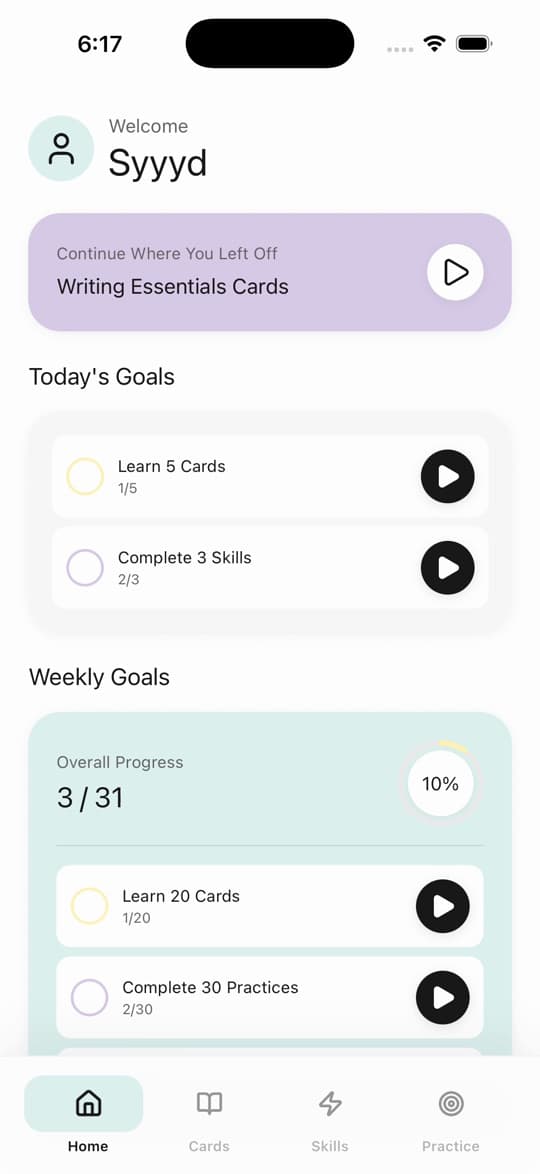
Three surfaces, tied together by one progress system. Encouraging, never childish.
Cards
452 academic phrases in 9 categories. Overdue cards come first.
Skills
Writing split into 4 drills, one sub-skill at a time.
Practice
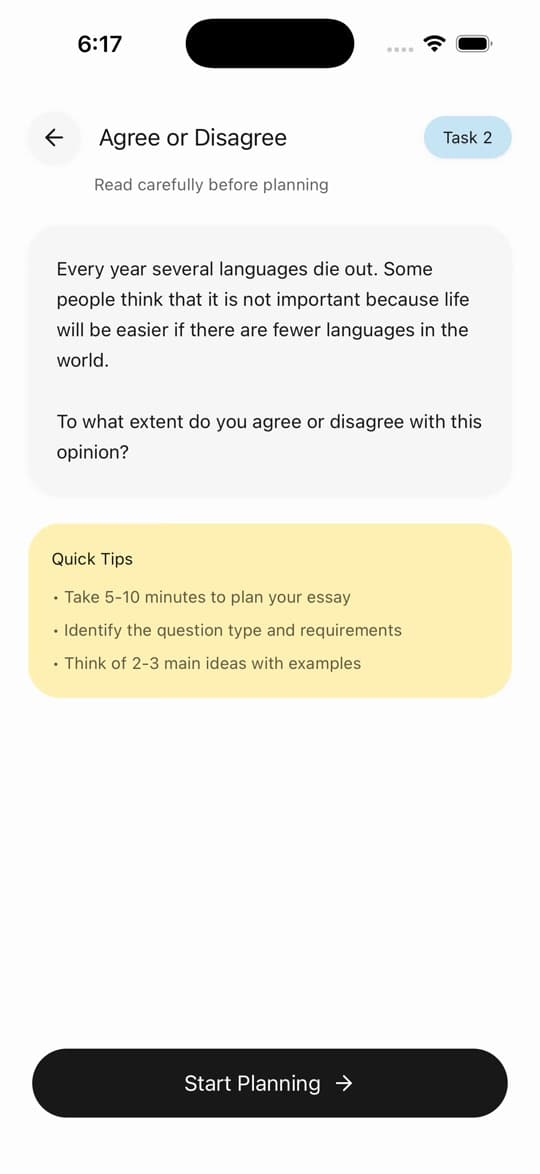
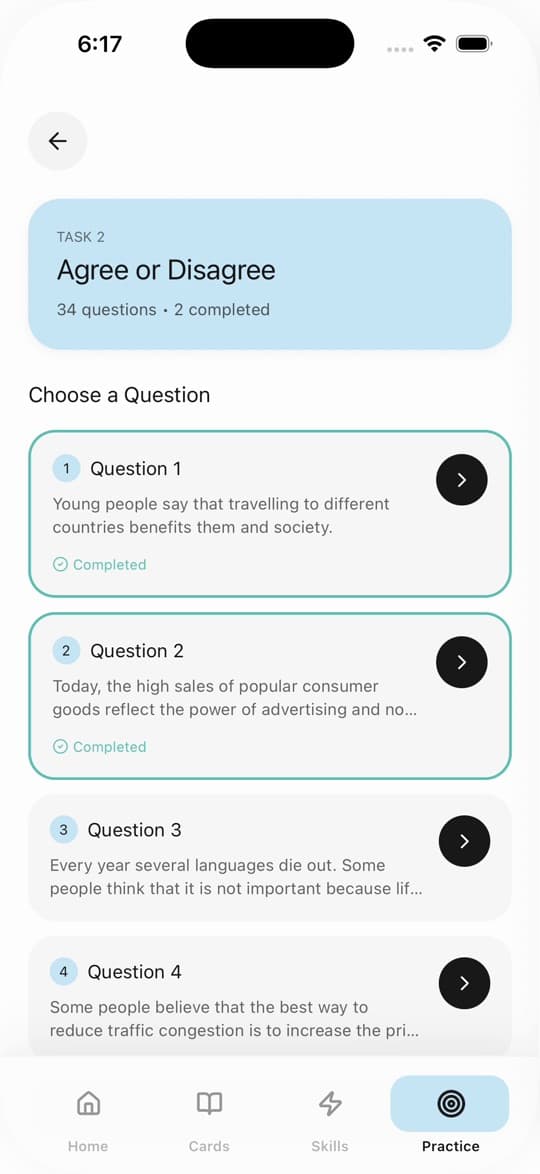
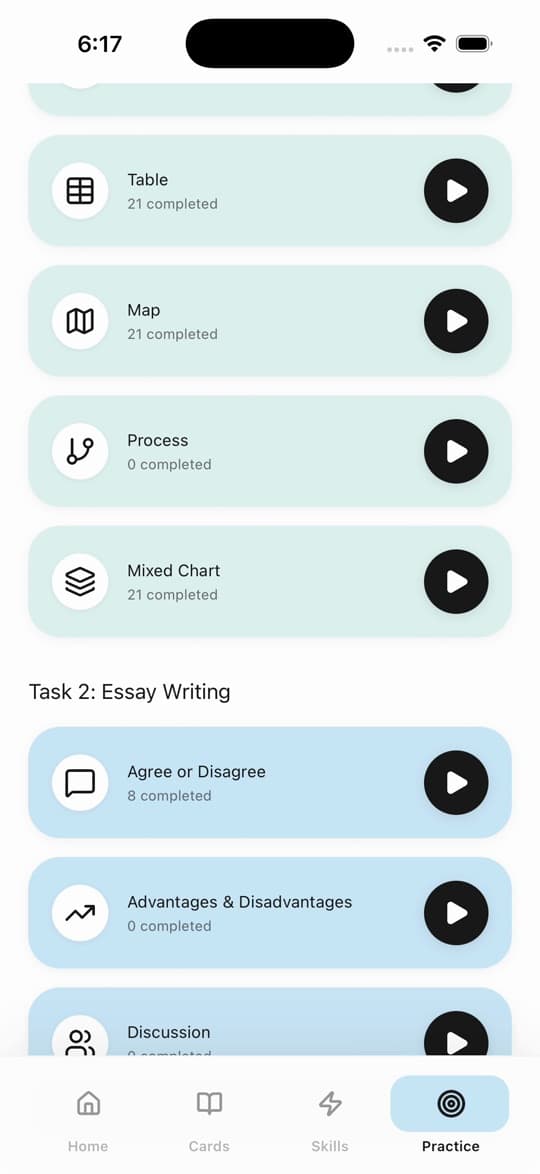
The full exam. 131 prompts and 48 charts. Plan, check the plan, then write.
Locked down underneath
63 row-level security policies. The AI box is treated as hostile input.
- React Native
- Expo
- TypeScript
- NativeWind
- Supabase
- Postgres
- Claude
- Maestro
- React Native
- Expo
- TypeScript
- NativeWind
- Supabase
- Postgres
- Claude
- Maestro
Where It Is Now
Built end to end. Two of us on the company, with product and engineering mine. The scope is real rather than a prototype's: about 60 screens, 26 migrations, two Edge Functions, and content tables with 452 phrases sitting in them.
What I can't show you yet is whether it moved anyone's band score. That's the only number that would prove the thing works, and getting it means putting it in front of a cohort and waiting for them to sit the exam.