
Ringa
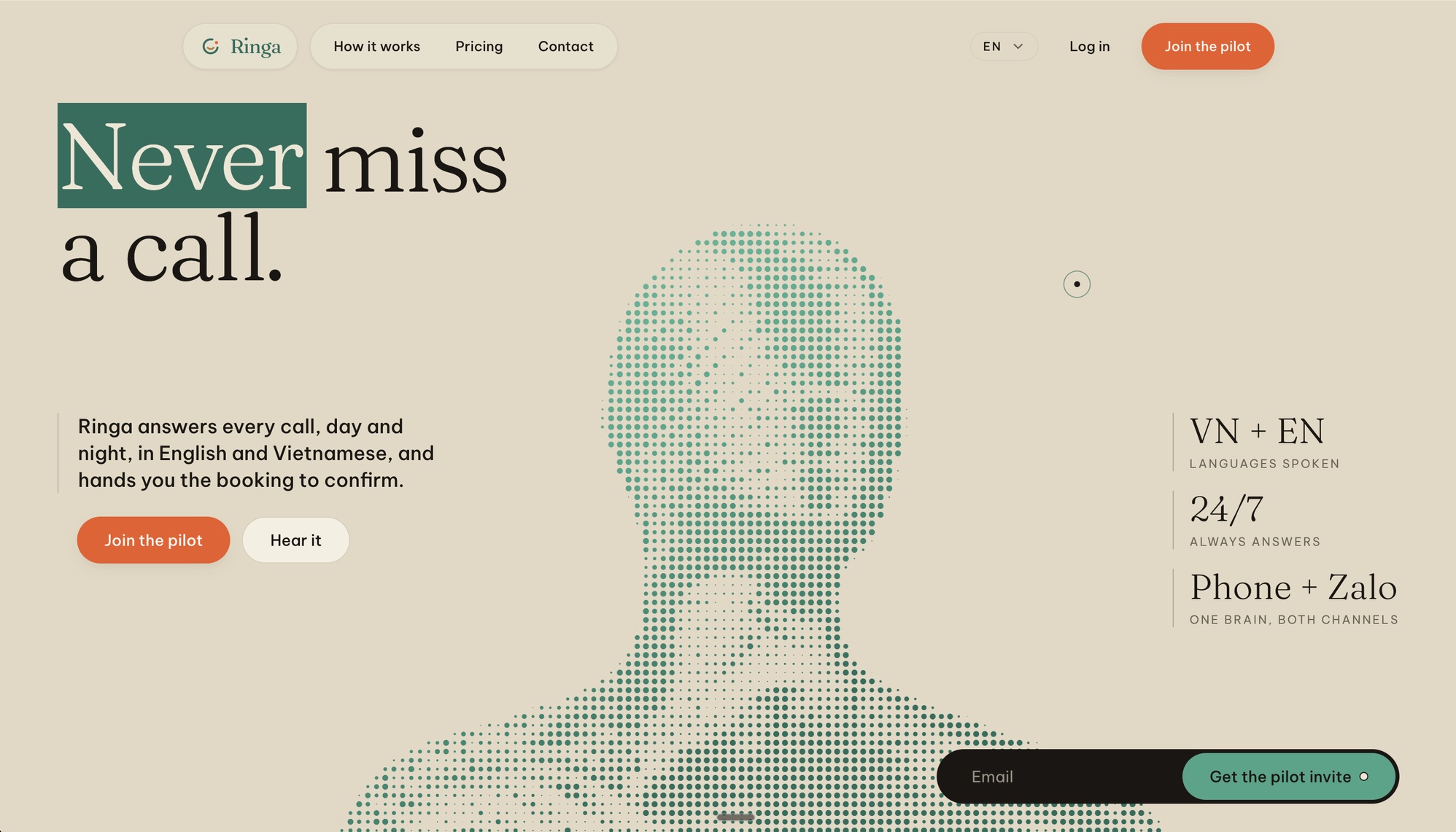
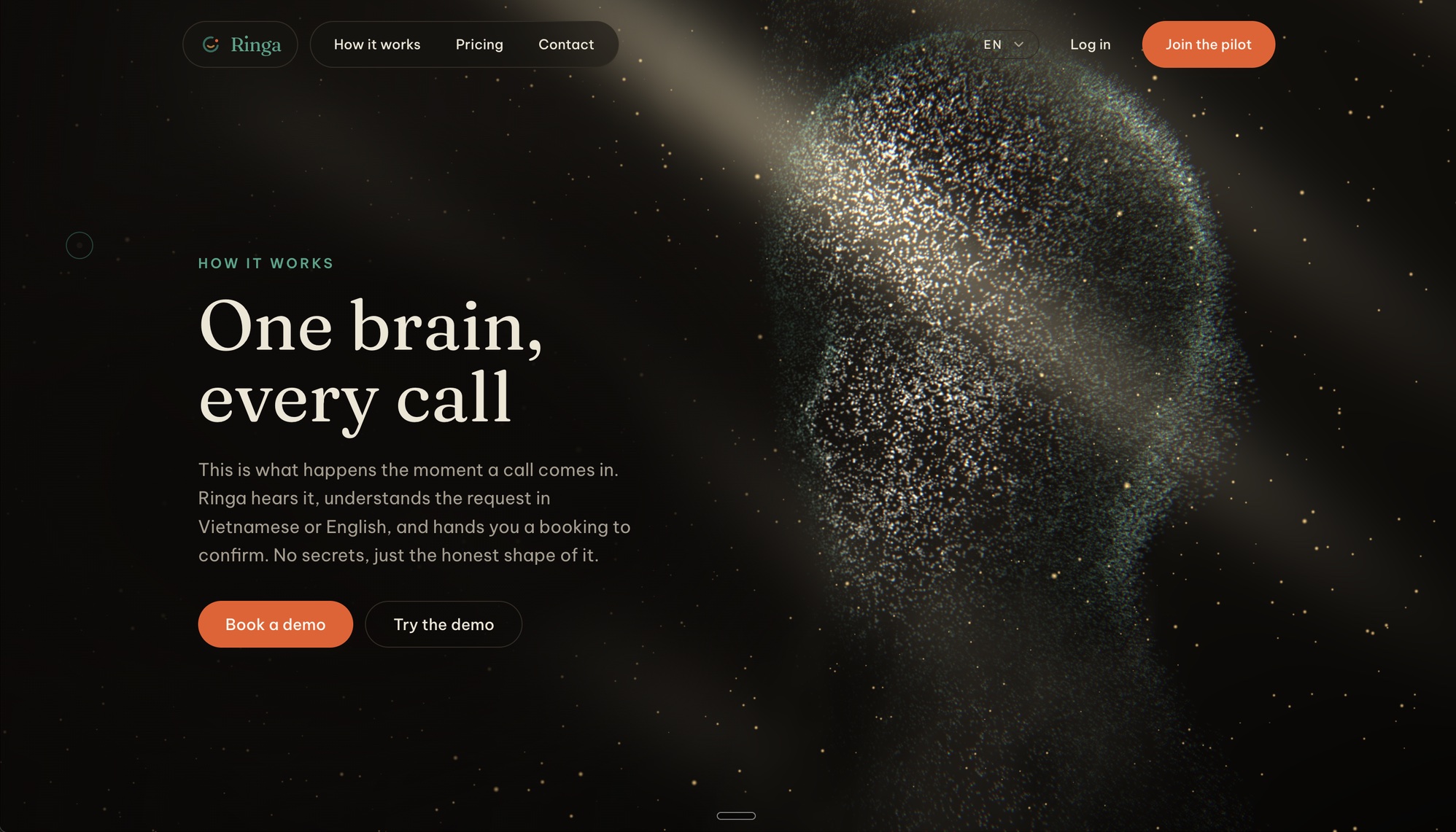
Ringa is a multilingual AI call agent for small businesses in Vietnam. It answers the phone in Vietnamese or English, handles a booking conversation end to end, and hands the request to the owner to confirm. I co-founded it in 2026. It's at working-demo stage: the voice pipeline runs against real providers, and the telephony is designed but not wired yet.
The Problem
Salons, clinics, restaurants and gyms live on appointments, but the phone gets answered by whoever's free. During busy hours that's nobody. The call rings out, the customer books next door, and nobody's counting it, so nobody knows what it costs them.
The gap is specific. FPT.AI, Vbee and Viettel all sell voicebots here, and they all sell them to banks and telcos. Nobody is serving the small booking-led business, which is the one losing a customer every time the phone rings out.
The Decisions
- 01
Request only, never promise a slot
Ringa captures a request, reads the five fields back to the caller, and saves it. It never tells anyone a slot is free. There's no calendar and no availability model, so the owner confirms every booking themselves. That meant giving up the “fully automated booking” pitch, which is the thing everyone wants to hear. It also took the single biggest engineering job out of v1, and it makes double-booking structurally impossible rather than a bug we'd spend the next year chasing. Mostly it matches how these businesses already run, which is the part that actually matters.
- 02
Three dependencies, and no agent framework
The service runs on three production dependencies: the Anthropic SDK, ws, and Zod. No LangChain, no agent framework. The conversation logic is written straight against the provider streams instead. Latency and interruption handling aren't plumbing on this product, they're the product, and neither one survives a framework's abstraction layer. A framework would have saved me a week up front and cost me the two things the whole thing gets judged on.
- 03
Voice and Zalo from day one, not voice first
Vietnam is moving from calls to messaging faster than most places, so a voice-only product fights the tide. Zalo carries no speech-recognition risk, lighter regulation, and no telephony to build, so it ships lean while the voice side gets de-risked separately. Building both at once is more work up front. It also means the product isn't betting everything on the harder half.
- 04
Press 1 for Vietnamese, press 2 for English
No automatic language detection. Detecting it is the demo everyone wants, and it's a big risky piece of work: Deepgram's code-switching set doesn't even cover Vietnamese, and real-world accuracy on noisy code-switched phone audio is nowhere near what the vendor numbers suggest. Two keypresses cost the caller a second and took weeks of risk out of the build.
- 05
The reminder stayed, the review request got cut
Both were nice to have and only one could fit. The reminder attacks no-shows, which is money the owner has already lost. Review requests build reputation, which is slower and doesn't bring anything back. When something had to go, I cut the one that didn't recover revenue.
What Shipped
It works on real providers, with a browser demo you can talk to. First audio back is under 800ms at p50.
Answers, books, hands off
It answers from each business's own knowledge base and takes the booking. Not sure? It hands off to a human.
Swap a vendor in one file
Business code never imports a vendor SDK, so Cartesia to Rime is a 1-file change.
It doesn't stop at every “uh huh”
It can tell a real interruption from a caller just saying “vâng”. Pranks and abuse hit a hard backstop.
Tests that still mean something next week
The eval baseline is fingerprinted, so a pass stays a pass. Browser tests play real caller audio.
- TypeScript
- Node
- Deepgram
- Claude
- Cartesia
- OpenAI Realtime
- LiveKit
- Zalo
- TypeScript
- Node
- Deepgram
- Claude
- Cartesia
- OpenAI Realtime
- LiveKit
- Zalo
Ringa Dashboard
Where the business sees what the agent did, and decides what happens next.
The agent answers the phone. This is the other end of it.
A call arrives here as a request to confirm or decline, never as a booking that already happened, which is the same rule the agent follows out loud. Around that sit a calendar, an activity log, and every call with its recording and a note when one ended badly.
What you can see depends on who you are. Staff at the desk get the requests, the calendar and the calls. The shop's settings stay with the owner.

Where It Is Now
Working-demo stage. You can hold a booking conversation with it in a browser, and the voice pipeline is running against real providers rather than mocks.
What isn't there: real phone calls. Stringee to LiveKit is designed and not wired, and Vietnamese voice quality on a noisy mobile call is unproven until it's tested on one. No pilot salon, no usage numbers. I'd rather say that than let a demo imply otherwise.
Salons first, clinics second. Single-location and booking-led, in Ho Chi Minh City. The buyer is the owner, not an IT department, and we're aiming at 200 to 400k dong a month, where one saved booking a week covers it.
Ishan holds the Vietnamese entity and the verified Zalo official account. That isn't an administrative footnote. It's a regulatory constraint that shaped what we could build and the order we could build it in.